Every gap owned. Every fix signed off.
When regulation moves, Amoreg now carries each gap from discovery to a signed-off fix, with the right person on every step and the whole trail on record.
When a regulator revises a handbook, reading it is the easy part. The hard part comes after. Someone has to work out which policies now fall short, get each gap to the right person, agree the fix and later prove who signed it off. Most firms run that through spreadsheets and email threads, and when a supervisor asks how the firm responded, the answer has to be pieced back together.
The rebuilt Findings turns that scramble into one calm flow. Every gap arrives with the person who should own it, a fix Inspector can draft and a named approver, and every step lands on the record as it happens.
Every gap lands with the right person#
A finding is a gap between what a regulator now expects and what one of your documents says. Inspector, Amoreg's reviewing agent, raises it with the rule, the document and the exact section, so nobody starts from a blank page.
Ownership follows your documents. A policy with a single owner sends its gaps straight to them. Where several people share a policy, Inspector can recommend who should take it and explain why, and an admin confirms in one click. Nobody has to chase who should pick it up.
The fix is drafted for you#
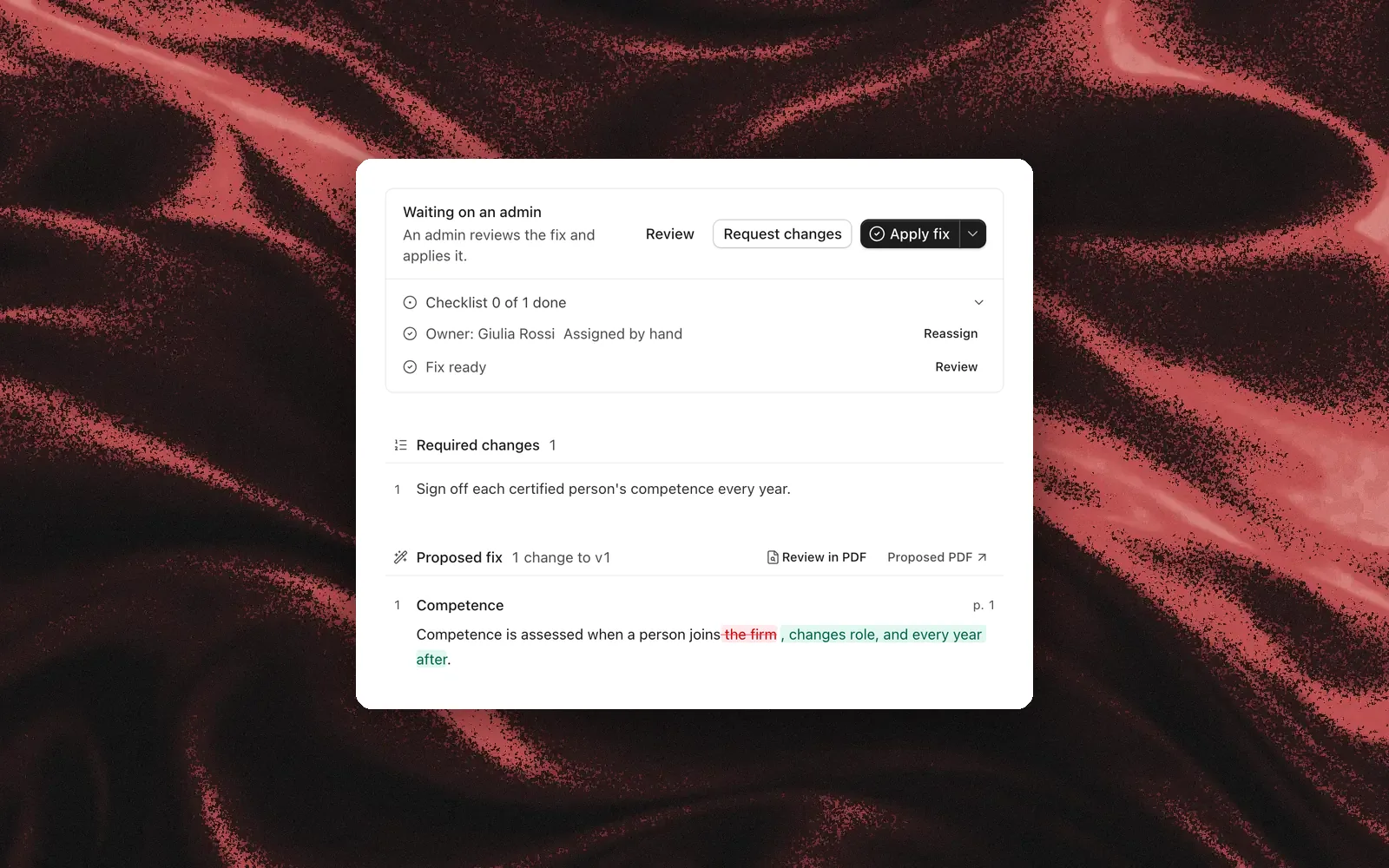
Take a fictional firm reviewing its Training and Competence Policy against its own internal requirement for a yearly competence sign-off. This is an illustrative policy gap, not a claim that a regulator has introduced a new annual sign-off rule. Giulia owns the gap. Instead of writing new wording from scratch, she asks Inspector, which returns a redline of the policy covering the required changes.
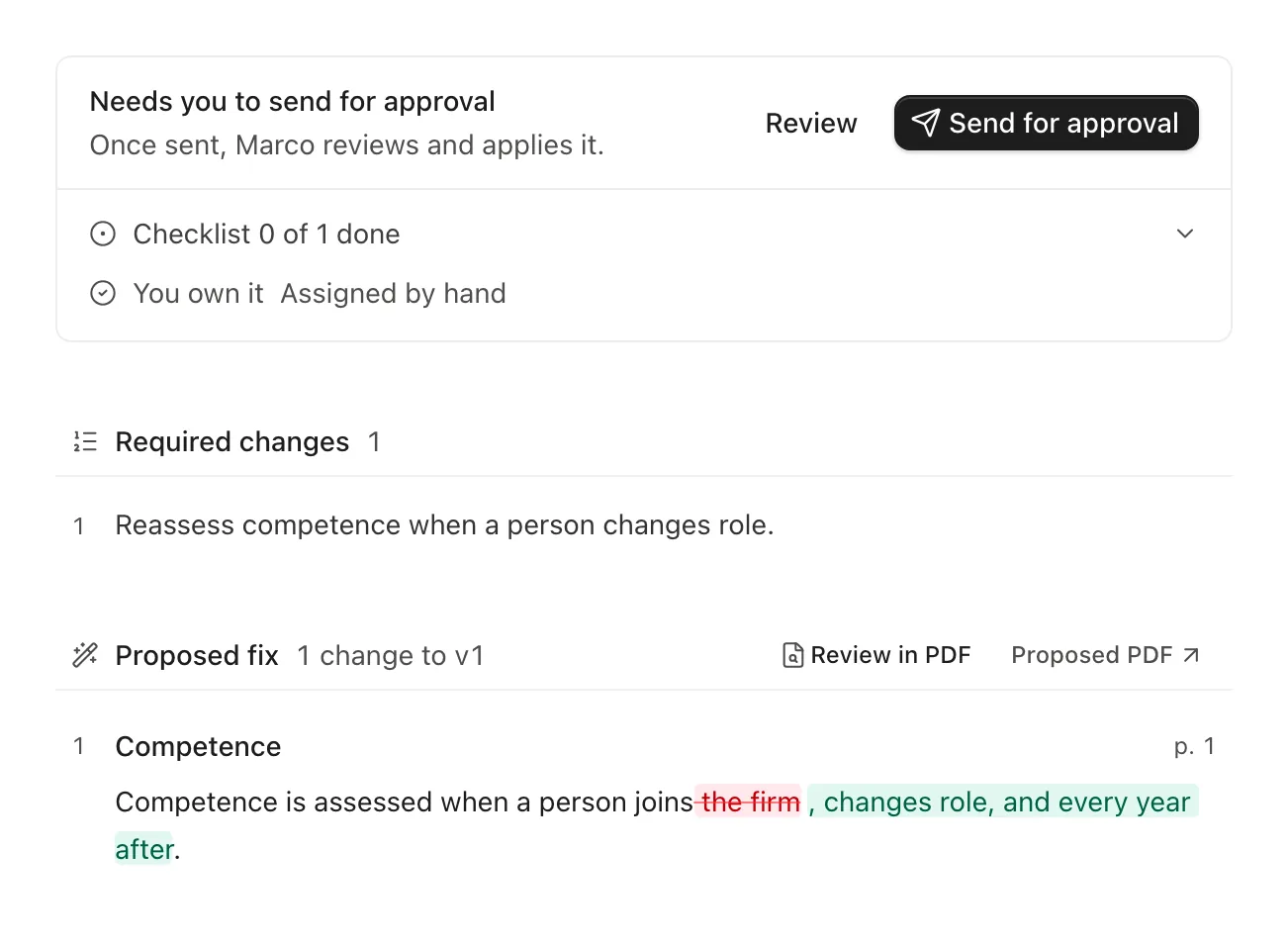
She stays in control of what goes forward. In this example, Giulia prepares the fix and Marco is the admin who reviews and applies it. Sending the finding for approval brings that decision to him.
Decisions come to the people who make them#
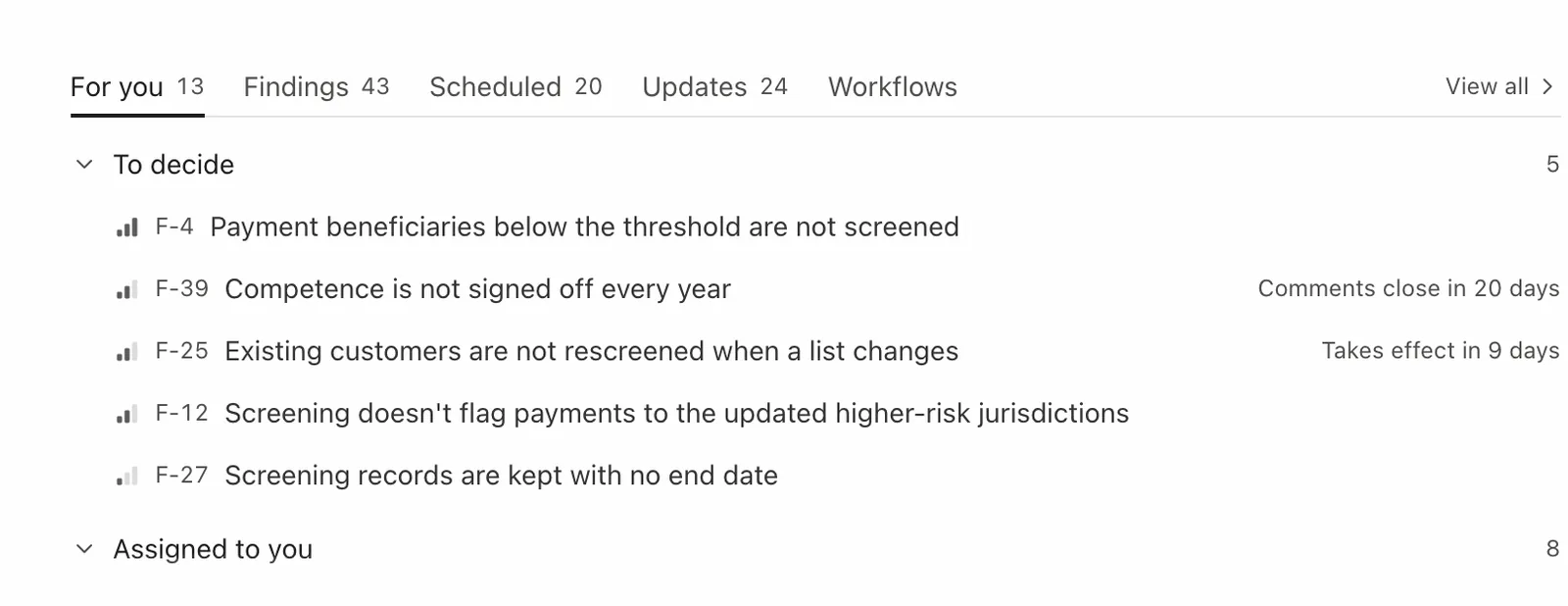
Marco, the admin, never has to go looking. The request appears on his Home under To decide, kept apart from the work assigned to him, and rises to the top of his Inbox.
He reviews the proposed wording on the policy's own pages, before and after, and either applies it or sends it back with a note. Here he asks for one change.
Back and forth, without the email chain#
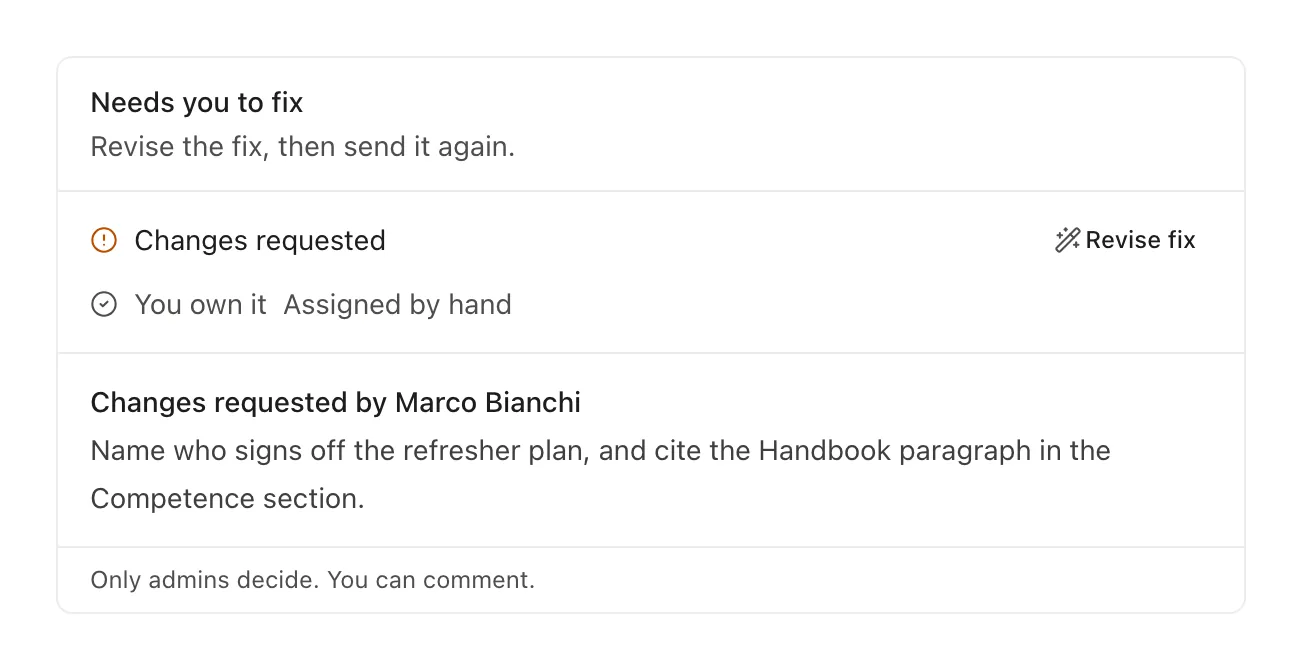
Giulia sees Marco's note on the finding itself. Inspector reworks the draft against it, and she sends the revision back. No attachments, no lost versions.
Marco applies it. Amoreg saves the policy's next version and closes the finding with that version as evidence. If the policy changes while a request is waiting, Amoreg withdraws it, so nobody approves a fix written against old wording.
What resolving a finding proves#
Saving the corrected policy records the wording that was approved. It does not prove that staff follow the policy, that a control operates effectively or that the firm complies with every applicable rule. Those conclusions need their own evidence, such as completed records, testing and review of the results. Keep any outstanding operational validation separate from the completed policy edit.
The distinction also matters when a finding is dismissed. A dismissal needs a written reason; it records a decision that the proposed change is not being made, rather than proof that remediation succeeded.
Who can decide, and what can be reopened#
An admin can resolve or dismiss a finding. An admin can also grant a named member permission for that decision action, either across the organisation or only on documents they own. Being the policy owner does not itself grant that permission. Inspector can propose and revise a fix, but cannot make the human decision to resolve or dismiss the finding.
Reopening remains an admin action. A different decision cannot overwrite a resolved or dismissed finding directly: reopen it first. The document activity records the transitions and who made them.
An answer ready for your supervisor#
Every closed finding keeps its whole story on one page: the rule, the gap, who owned it and why, the words that changed, who proposed them, what the admin asked for and who signed off. When a supervisor asks how you responded to a change, you send a page, not a reconstruction.
The pictures in this article come from a fictional firm. To see Findings on your own library, book a walkthrough and we will take you through a recent publication.